A QUICK SURVEY OF FOOD HISTORY
We don’t have to go back far to capture the history of fat. Food moved from farms to factories in the 1800s. Instead of smaller, local farms producing the majority of what people ate, large factories made foods with a long self life that could be shipped long distances.
Innovation in the food industry was driven by war. Canning came along during the Civil War to preserve food for soldiers; dried foods such as dehydrated beef was shipped overseas during World War I, and reconstituted, desiccated meals, such as soup, were introduced during World War II. Freeze-dried foods were created some time after that. Processed foods were then rebranded as convenience foods and became widely available to the public filling large grocery store shelves after the first boxed cake mix appeared in the 1950s.
Marketing these new foods required extreme measures because it was hard to sell at first. It was pretty close to propaganda. After World War II, women stayed in the workforce, and the idea of convenience food hit a nerve with wives who were still feeling compelled to have a homemade cake ready for dinner. That was how the first cake mix was sold. Convenience food was born!
Most of the food we eat today didn’t exist 100 years ago. Even the molecular structure had changed. Fat is the most important processed food to understand because cell membranes are virtually made of fat, and it makes up roughly 50% of the human brain. Unfortunately, processed oils have foreign molecules that don’t integrate into our cellular structure. To make matters worse, they’re added to nearly all processed food, contributing to the epidemic of chronic illness we see today.
MORE TO COME IN A SERIES OF ARTICLES
In the next article I’ll explain more about what these fats do in the body, and I’ll give some practicle tips on which fats to eat and which ones to avoid, which ones can be used for skincare, etc.
Throughout history, fat was extremely valuable because it’s so essential for good health. The majority of nutritional debates concern fat, and the contention continues on, so let’s get the story straight.
What kind of fat did ancient people eat?
People ate tallow from beef, butter and cream from cows, sheep, and goats, lard from pigs, suet from lambs, and in Asian culture, they used coconut oil and palm oil, which are also considered traditional fats. They are naturally saturated fats, just as animal fat is.
Vegetable oil isn’t from vegetables. It’s from seeds, which is why the correct term is seed oils. These oils include corn oil, cottonseed oil, safflower oil, soybean oil, canola oil (rapeseed), and peanut oil. Soybean oil is the most common fat added to processed foods now, and there are multiple problems with soybean oil.
Seed oils are cheaper than animal fat, which is why they’re used in restaurants and in processed food. They make food taste better and feel more satisfying, and they are part of the addictive formula food scientists use in creating addictive, processed foods. That’s one reasons they’re added to almost everything we eat now.
The addiction formula I just mentioned is a combination of fat, sweet, salty, and crunchy. Fat adds flavor and satiety, and it also creates the crunch. The best example is a flavored tortilla chip. Addiction is created by layering these flavors, textures, and the mouth feel of fat, so that every bite delivers the maximum effect on the taste buds, which excites the nervous system. It provides a dopamine hit!
The Industrial Revolution
Whale oil was the primary machine lubricant used during the Industrial Revolution, until so many whales were killed off that they became endangered. Between 1820 and 1860, cottonseed oil replaced whale oil as engine oil. Cottonseed was a waste product of cotton crops and not considered edible. Procter & Gamble, soapmakers, took that trash heap and created Crisco, the first seed oil introduced as food. But before I tell that story, let’s talk about the chemical makeup of the different kinds of fats.
The Science
There are three kinds of fats: saturated, polyunsaturated, and monounsaturated.
First, saturated fats are animal fats, coconut oil, and palm oil
This is what a saturated fat molecule looks like:

A saturated fat molecule contains carbon atoms that are “saturated” with hydrogen, meaning, each bond is occupied by a hydrogen atom, and, therefore, they’re stable molecules. They’re not “grabby.” They lie flat and can be densely packed. This is what makes them solid.
Because they are saturated, they remain fresh, even when sitting in the open air. They do not oxidize and become rancid because there is no open bond where an oxygen atom can make its way into the structure.
Second, polyunsaturated fats are seed oils, and this is what they look like:
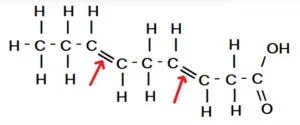
Polyunsaturated fats have carbon atoms with some double bonds creating kinks in the fatty acid chains. They are bent and twisted. They cannot be densely packed together, which creates open spaces between the molecules. Because of this, they are liquids.
They’re unstable because the double bonds unlink and grab onto other things like oxygen floating by. Remember, water has an oxygen atom in it, and our body fluids are mostly water.
Oxidation is the chemical process that breaks fats down. This is how they become rancid.
This is the same reaction iron has when it’s exposed to air. Our cell membranes are made of fats, and when seed oils get lodged cellular structure, we experience oxidation. We “rust,” if you will. If you hear the term “oxidation” as a cause of inflammation, think “seed oils.”
Seed oils are the number one cause of inflammation coming from food. Sugar isn’t healthy, but it doesn’t get lodged in the trillions of cellular membranes in our bodies. It moves on through our system quickly. Fat doesn’t move through our bodies quickly because we are literally constructed from fat.
For that matter, anything that is fat soluble can become a bigger problem in the body than water soluble substances. Most modern toxins are fat soluble. This is one of the reasons detoxification can be challenging.
Third, monounsaturated fat is olive oil.
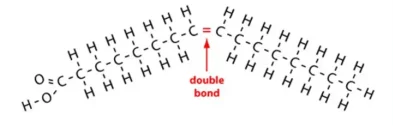
Monounsaturated fat has only one double bond in the chain. It’s still a liquid, but it’s more stable than polyunsaturated fat because it’s almost fully saturated with hydrogen. It has good health value and it’s generally not highly processed.
The Trouble with Polyunsaturated fats
Since seed oils pick up oxygen easily as they’re processed, they are a rancid, grey liquid. In order to make them appealing, they have to be deodorized and winterized.
A process called hydrogenation adds hydrogen atoms into the molecules at the double bonds. They straighten, but they remain twisted. This creates solid, stable oils known as shortening and margarine.
Making grey, rancid oils appealing requires a lot of machinery. These are huge, multi-level factories, and the oils are run through many steps. They’re highly processed! And they’re cheap because they’re sourced from waste products.
Back to Crisco
The first seed oil was Crisco, made by Procter & Gamble around 1910. They hydrogenated cottonseed oil and made the first shortening. It looked like lard, so they sold it as a “clean” replacement for lard. Lard was the most common cooking fat.
Young people at that time thought anything made in a factory was an improvement on old-world ways, so they carpet-bombed households with a campaign promising a “new, modern, and cleaner” product to young women. It didn’t come from a bloody slaughterhouse. It was made in a pristine factory filled with shiny steel and enameled surfaces, like a science lab.
The Book of Crisco, published by Procter & Gamble, reads, “While Crisco may be a shock to the older generation, born in an age less progressive than our own, a modern woman is glad to give up butter and lard just as her grandmother was happy to forego the fatiguing spinning wheel.”
A Health Crisis
It wasn’t long before heart attacks became a common and frightening health condition. President Lyndon B Johnson had a heart attack that scared the nation, and they prescribed a “cleaner” diet based on vegetable oils, declaring animal fat the cause of his health problems.
This gave rise to a lot of faulty research, and the food industry moved to decades of processed, fat-free products. Warnings about saturated fats of every kind became standard diet dogma. Many traditional foods that had been eaten for centuries became suspect: eggs, butter, coconut oil, and fatty cuts of meat.
In order to avoid processed foods, we need to be aware of highly processed seed oils, which are still newcomers to the food we eat. Because fat takes up residence in our cell membranes, it can take a long time to clear from our bodies.
Resource:
Teicholz N. The Big Fat Surprise : Why Meat, Butter, and Cheese Belong in a Healthy Diet. Brunswick, Victoria Scribe Publications; 2014.